
RIVANNA Launches Teach-Accuro, a CRNA Educators Project
Aug 4, 2021
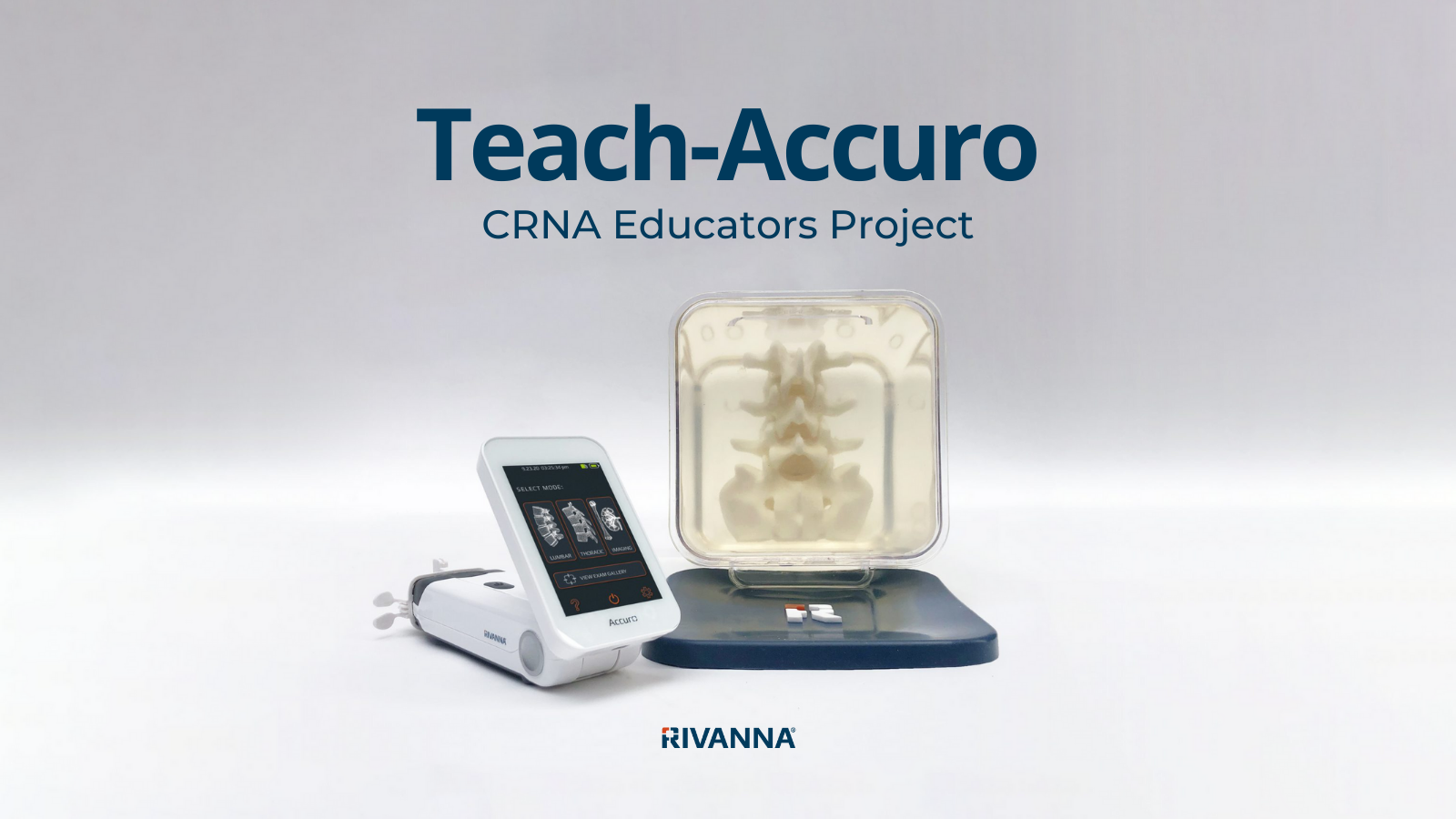
Teach Accuro
CRNA Educators project by RIVANNA
RIVANNA®, developers of world-first, imaging-based medical solutions, today announced the first semester of the Teach-Accuro CRNA Educators Project. The new initiative provides the Accuro® spinal navigation system at no cost to qualified CRNA training programs interested in integrating the Accuro image-guided neuraxial technique into their curriculum. Resources include the Accuro and related consumables, training phantoms, lecture materials and an online education module covering neuraxial anesthesia and neuraxial ultrasound.
Accuro, the first ultrasound-based system specifically designed for neuraxial anesthesia, combines Multi-Frequency BoneEnhance® Image Reconstruction for significantly enhanced bone-to-tissue contrast and SpineNav3D™ AI-Enabled Image Recognition for automated, real-time image guidance. Accuro's world-first technology helps providers achieve improved localization of the desired intervertebral space for first-attempt success during spinal needle guidance procedures. Ongoing clinical trials and research demonstrate Accuro's efficacy and its benefits in promoting procedure safety, efficiency and patient satisfaction.
Richard Flowers DNP, CRNA, CHSE, at Wake Forest University School of Medicine, commented, "Teach-Accuro is providing CRNA educators like myself a novel way to introduce image guidance as part of our neuraxial ultrasound curriculum. Practicing with an AI-enabled training solution like Accuro will heighten learning and facilitate increased awareness and adoption of vital imaging modalities. I anticipate this program will have a positive effect, not only on improving the scanning skills of these clinicians but on patient outcomes as well."
Training using pre-procedural ultrasound-guided neuraxial anesthesia is a viable way to improve scanning skills and increase the frequency of use before performing epidural or spinal needle placement procedures. In a study published in the Canadian Journal of Anesthesia, researchers evaluated ultrasound imaging for teaching epidural anesthesia in obstetrics. They found a higher rate of success during the first 60 attempts compared to conventional teaching. Researchers observed that in the control group, the rate of success started at 60 percent and within 50 epidural insertions, it increased to 84 percent. In the ultrasound group, the rate of success started at 86 percent and within 50 epidural insertions, it increased to 94 percent. The difference between the two groups remained significant (P < 0.001).
Clinicians can practice spinal needle guidance procedures with Accuro during labs and increase neuraxial ultrasound competence via the online education module. Wake Forest School of Medicine has completed one semester of the Teach-Accuro program. Additional institutions are teaching entry-level SRNAs neuraxial anatomy and regional techniques with Accuro during the summer of 2021.
Press Release Service by Newswire.com
Original Source: RIVANNA Launches Teach-Accuro, a CRNA Educators Project
More News





.jpeg?itok=MwUlAfbZ)





Recommended










YOUR NEWS, OUR NETWORK.
Do you have Great News you want to tell the world?
Be it updates about your business or your community, you can make sure that it’s heard by submitting your story to our network reaching hundreds of news sites across 6 verticals.